







Long before Pinehurst became the home of American golf, long before anyone dreamed a buddies trip or a golf course community, a wooden crate arrived in Charleston, S.C., harbor carrying the game itself.
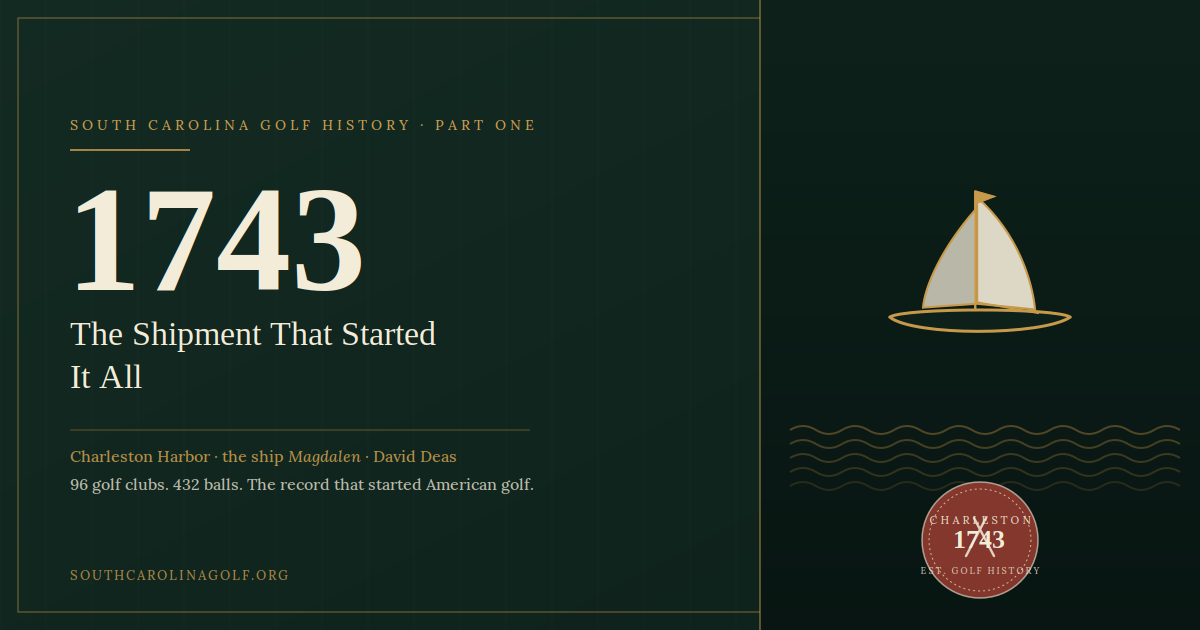
In the spring of 1743, a merchant vessel called the Magdalen, under Captain William Carse, cleared the port of Leith – a harbor town outside Edinburgh where golf had already been played for centuries – bound for Charleston. Tucked among a cargo of salt and sailcloth was something far less ordinary for a colonial shipping manifest: ninety-six golf clubs and 432 golf balls, consigned to a young merchant named David Deas.
Deas, a Scottish-born trader who had grown up around the Leith Links, took delivery of the shipment that August. It is the earliest documented, large-scale arrival of golf equipment anywhere in what would become the United States, and the volume is the detail that turns this from a curiosity into a milestone. A single 18th-century golfer typically played with five to eight clubs. Ninety-six clubs and 432 balls were enough to outfit more than a dozen players many times over. Historians who have studied the record, including Charles Price and George C. Rogers Jr., authors of The Carolina Lowcountry, Birthplace of American Golf, 1786, read that as evidence Deas wasn’t just buying for himself. He was outfitting a golf crowd that already existed, or was about to.
The Record Almost Didn’t Survive
For most of American history, the 1743 shipment was a piece of oral and genealogical tradition rather than hard proof – a well-worn Charleston story without a document to back it up. That changed thanks to Gantt Folline, a Mount Pleasant commercial real estate appraiser and a descendant of the Deas family, who spent years chasing the paper trail through the South Carolina Gazette and the archives in Edinburgh. After months of correspondence with Scottish archivists, Folline tracked down the original shipping record confirming the date, the ship, and the cargo. The find gave Charleston’s golf origin story something rare in colonial history: a name, a date, and a bill of goods.
The story was striking enough that it inspired art as well as scholarship. Charleston painter Carol Ezell-Gilson captured the moment in First Shipment of Golf Clubs to America, commissioned for Golf Expo 1990 ahead of the Ryder Cup’s arrival at Kiawah Island’s Ocean Course the following year. The painting still hangs in the Charleston area today, a crate of clubs cracked open on a ship’s deck, the Lowcountry marsh visible in the background.
Why It Matters
South Carolina’s claim to being the birthplace of organized golf in America doesn’t rest on the shipment alone. Forty-three years later, in 1786, a group of Charleston golfers formalized their pastime as the South Carolina Golf Club, believed to be the first golf club in the country, playing over an open pastureland on the Charleston peninsula known as Harleston Green, near the present-day corner of Pitt and Bull streets. Members gathered at a coffeehouse before heading out to play, using a “play club” for driving and a utility iron for short shots, with feather-stuffed “featherie” balls.
The 1743 shipment is the moment that made all of it possible. Without equipment, there’s no golf club, no green, no Harleston Village legacy for later generations of Charleston golfers to point to. It’s why South Carolina license plates have carried the words “First in Golf,” and why every major championship that has since touched South Carolina soil – from that 1991 Ryder Cup to the PGA Championship’s visits to Kiawah – plays out in the shadow of a crate that came off a ship nearly 300 years ago.
A Footnote Still Being Written
Golf history has a way of rewriting itself. In 2026, historian Dr. David Dobson uncovered a ledger in the National Records of Scotland showing an Edinburgh businessman named Andrew Wallace paying for golf clubs and golf balls in 1739 – four years before the Deas shipment – consigned to his brother, William Wallace, a Charleston merchant. Charleston County Public Library historian Dr. Nic Butler has since connected William Wallace to Charleston business circles active in that era. If the connection holds up, it wouldn’t erase the significance of the Deas shipment, still the largest and best-documented of the two, but it’s a reminder that Charleston’s golf story may run even deeper than the record has shown so far, and that there’s more waiting to be found in the archives.